
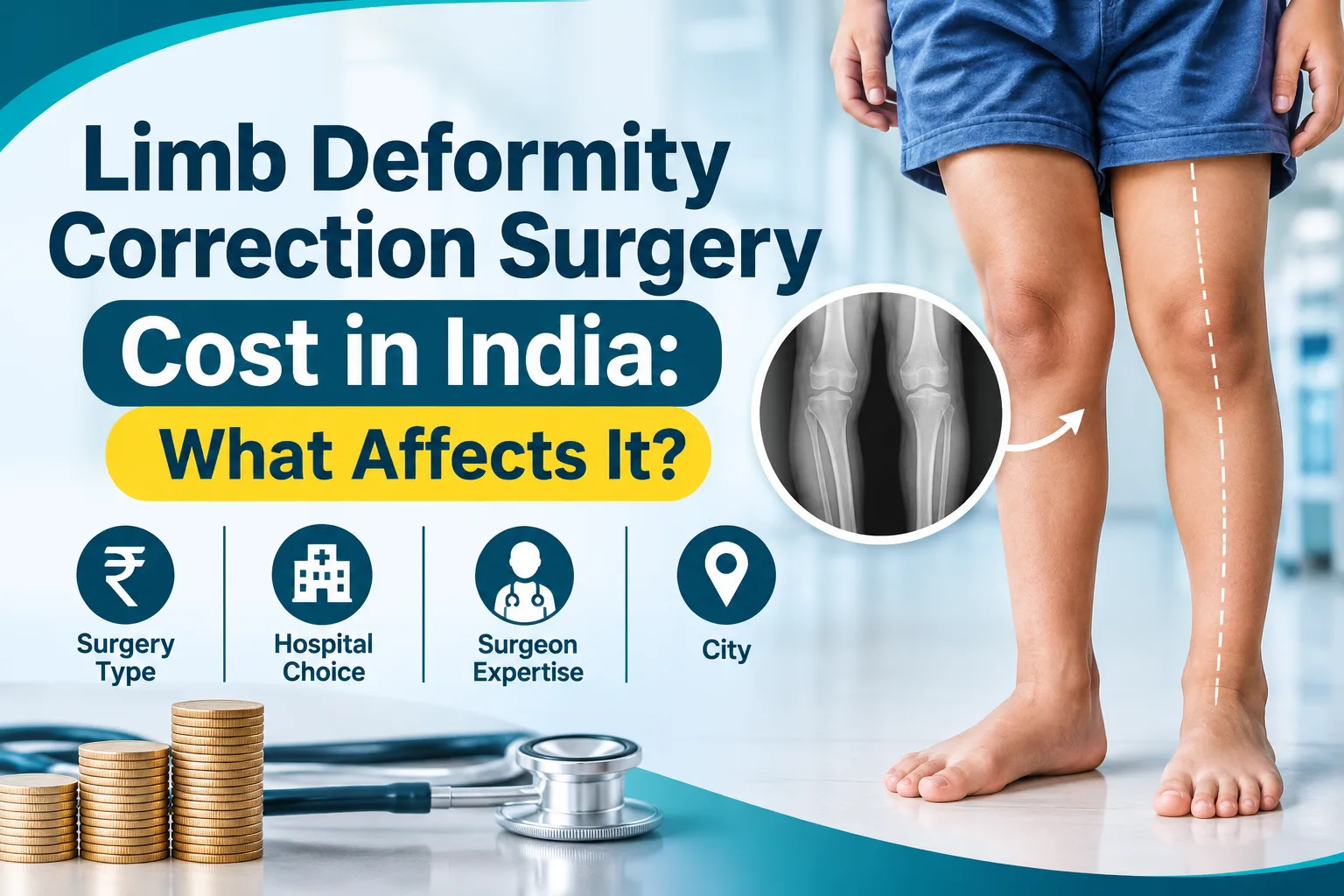
The cost of limb deformity correction in India depends mostly on the method. Quick correction with a plate or nail is usually cheaper than gradual correction with an Ilizarov or hexapod frame, which needs months of follow-up. The number of bones being corrected, the implants used and the length of hospital stay also change the total.
If you’ve been quoted a figure for deformity correction and it seemed either surprisingly low or alarmingly high, the reason is usually in the plan, not the hospital. This guide explains what goes into the cost so you can compare quotes properly and avoid the surprises that come later.
What is the approximate cost of limb deformity correction at top hospitals in India?
There’s no single price, because “deformity correction” covers everything from a small guided-growth plate in a child to a year-long reconstruction with a frame. What we can say with confidence is how the cost is built up, and how the main methods compare. Real figures for your case come only after a surgeon has measured your X-rays.
Estimated ranges at Sankalp Multi-Specialty Hospital
| Method | Typical stay | Estimated range |
| Guided growth plates (children) | 1–2 days | ₹80,000 – ₹2,50,000 |
| Acute correction: osteotomy with plate or nail | 3–5 days | ₹1,50,000 – ₹4,00,000 |
| Gradual correction with Ilizarov or monolateral fixator | 5-7 days, plus frame removal | ₹2,00,000 – ₹5,00,000 |
These ranges cover one limb. Correcting both legs, or adding lengthening, changes the estimate.
What changes the price
• The method. Acute correction is one operation with an internal implant. Gradual correction means a frame, regular adjustments and a second, smaller operation to remove it.
• How many bones. Correcting the thigh bone and shin bone together, or both legs, adds operating time and implants.
• Type of frame or implant. Classic Ilizarov rings, monolateral fixators, computer-assisted hexapod frames and internal lengthening nails differ widely in cost.
• Hospital stay. Usually a few days after surgery. The Cleveland Clinic notes a typical stay of about three days for limb surgery of this kind, with recovery continuing for months at home.
• Physiotherapy. Essential to keep joints moving during correction.
• Follow-up. X-rays and frame checks every one to three weeks during gradual correction.
Plate, Ilizarov or hexapod: cost and trade-offs
| Method | Relative cost | Best suited for | Trade-offs |
| Osteotomy with plate or nail | ₹1,50,000 – ₹4,00,000 | Moderate deformities corrected in one step | Faster return to normal life; less suited to very large or combined deformities |
| Ilizarov ring frame | ₹2,00,000 – ₹5,00,000 | Large, combined or infected cases; deformity with shortening | Months in a frame; pin care; very adjustable |
| Monolateral fixator | ₹2,00,000 – ₹4,50,000 | Simpler gradual correction or lengthening | Less bulky than rings; fewer adjustment options |
| Hexapod frame | ₹4,00,000 – ₹8,00,000+ | Complex 3D deformities | Computer-planned adjustments; higher implant cost |
| Internal lengthening nail | ₹8,00,000 – ₹15,00,000+ | Lengthening with mild deformity in adults | No external frame; highest implant cost |
The Hospital for Special Surgery explains that external frames are still preferred for growing children, small bones and large deformities that can’t be corrected in one step, even where internal nails are available. A more expensive device isn’t automatically a better choice. The right method is the one that suits your deformity.
For a plain-language explanation of how frames work, see our guide to the Ilizarov method.
Costs people forget
• ☐ Frame removal surgery
• ☐ Dressings and pin-care supplies for several months
• ☐ Physiotherapy sessions after discharge
• ☐ Repeat X-rays at each follow-up
• ☐ Travel and stay for follow-up visits if you live far away
• ☐ A family member’s time off work during the first weeks
Ask for these to be listed in your estimate, even if they’re paid separately.
Insurance and payment options
• Health insurance generally covers deformity correction when it is medically needed: pain, limp, joint damage, or deformity after injury or infection. Purely cosmetic correction is usually excluded.
• Cashless treatment is available with several insurers and TPAs at Sankalp, including Star Health, ICICI Lombard and HDFC Ergo.
• Ayushman Bharat PM-JAY gives eligible families up to ₹5 lakh of cover a year, according to the Press Information Bureau. Check whether the hospital and procedure are covered before admission.
• Patients from abroad can ask for a written estimate in USD, GBP or AED and pay deposits online before travelling.
How to get an accurate estimate
Send full-length standing X-rays of both legs (hip to ankle), photos of the patient standing from the front and side, and any earlier reports. From these, Dr. Goyal can usually say which method fits, how long treatment will take and what it is likely to cost. More detail on our approach is on the deformity correction and limb lengthening page.
From the clinic, Dr. Tanay Goyal: “Two families can come in with what looks like the same bowed leg and leave with very different estimates. One may need a single osteotomy, the other a frame because there’s also shortening or an old infection. That’s why I don’t quote a number before I’ve measured the X-rays.”
Frequently asked questions
Is Ilizarov cheaper than a hexapod frame?
Usually, yes. Classic Ilizarov components cost less than hexapod frames. The choice should depend on the deformity, though, since both can give excellent results in the right case.
Does insurance cover deformity correction?
When correction is medically necessary, most policies cover it. Check your policy wording for exclusions on cosmetic procedures and limits on implants.
Is cosmetic correction covered?
Generally not. Procedures done only to change appearance or height are excluded by most insurers and government schemes.
How many follow-up visits are needed?
After acute correction, usually a few visits over three months. During gradual correction with a frame, visits are often every one to three weeks until the frame comes off.
Can I pay in instalments?
Payment usually follows treatment stages: a deposit at admission and the balance at discharge, with follow-up charges paid at each visit. Ask the billing team about the options available.
Next step
The fastest way to get a real number is to share real X-rays. Send standing X-rays for a deformity correction estimate and get a written plan before you decide.
Medically reviewed by Dr. Tanay Goyal, MS (Orthopaedics), fellowship-trained in limb reconstruction and deformity correction. Senior Consultant, Sankalp Multi-Specialty Hospital, Ambikapur.
This article is for general information. Costs are estimates and depend on each patient’s deformity, method and hospital stay.