
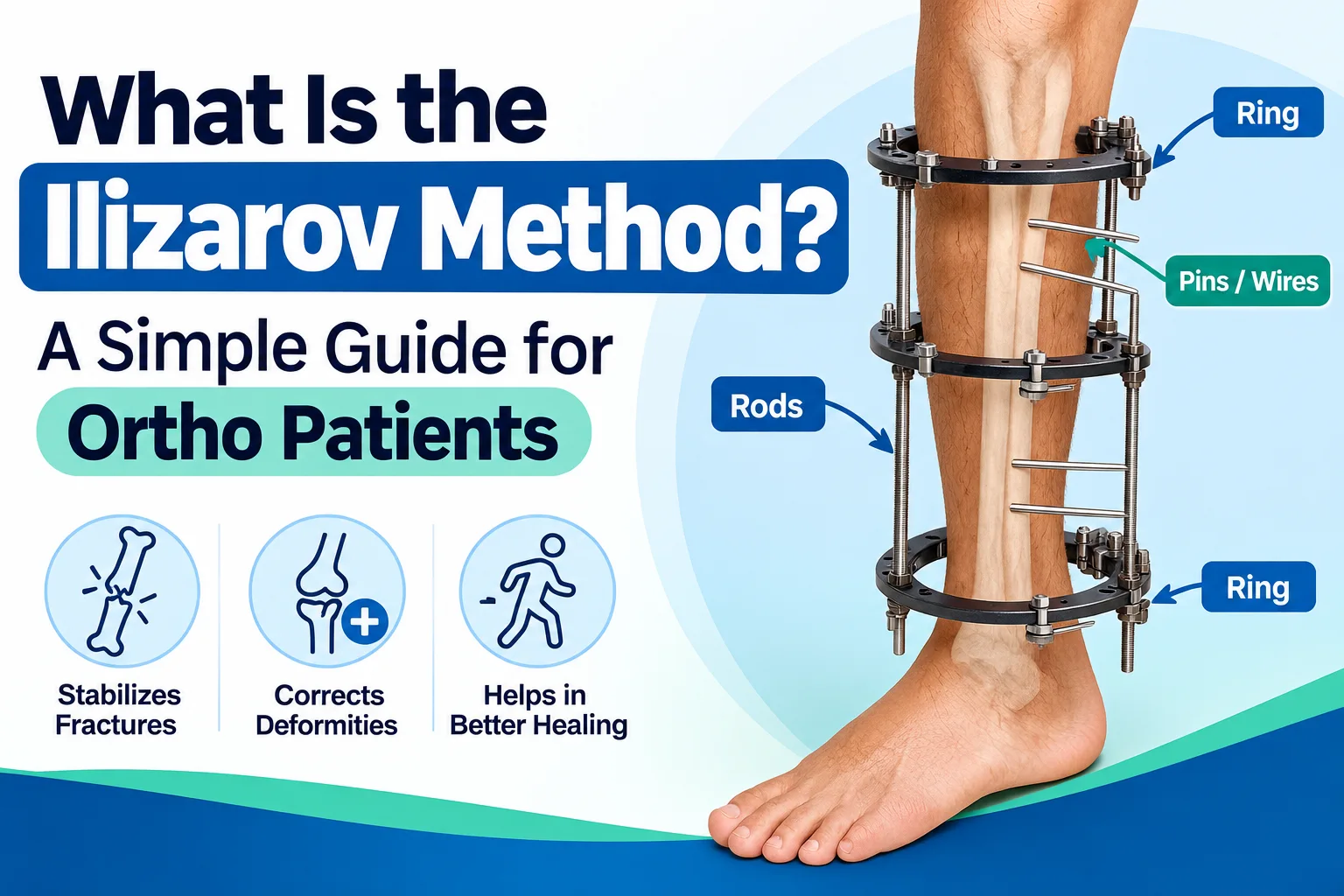
The Ilizarov method uses a ring-shaped frame attached to your bone from the outside to gradually lengthen, straighten, or rebuild it — using your body’s own ability to grow new bone when it’s pulled apart slowly and steadily. It sounds almost too simple to work, and yet it’s one of the most reliable techniques we have for problems that other approaches can’t fix: severe bone infections, limbs that won’t grow evenly, fractures that refuse to heal, and bone lost to trauma.
Patients who see the frame for the first time are usually alarmed by how it looks — rings, rods, and wires running through the skin into the bone. I understand the reaction. But once people understand what’s actually happening underneath, most find it far less frightening than it appears in photos.
Who was Ilizarov, and why does this method carry his name?
Gavriil Ilizarov was a Russian orthopedic surgeon working in Siberia in the 1950s, treating injured soldiers and civilians with limited resources and equipment. According to the historical record on this technique, Ilizarov built his first external fixators partly from bicycle parts. His breakthrough came almost by accident — a patient had assembled the frame backward, lengthening rather than compressing the bone, and Ilizarov noticed new bone forming in the gap instead of the bone simply failing to heal. That observation became the foundation for everything the technique does today.
The core idea: distraction osteogenesis
The Ilizarov method works on a principle called distraction osteogenesis — a term that sounds complicated but describes something your body already knows how to do. “Osteogenesis” just means bone formation; “distraction” means gradual pulling apart.
Here’s the sequence:
- The surgeon makes a controlled cut in the bone (called a corticotomy), which is different from a traumatic fracture because the surrounding blood supply and soft tissue are preserved as much as possible.
- A frame — rings connected by threaded rods, anchored to the bone with thin wires or pins — is fitted around the limb.
- After a short waiting period (usually 5–7 days) to let initial healing begin, the frame is adjusted gradually — often by turning small nuts on the rods, typically around 1mm per day, split into several small adjustments.
- As the bone segments are slowly pulled apart, the body fills the widening gap with new bone tissue, rather than the gap simply staying open.
- Once the desired length or correction is achieved, the frame stays in place for a longer “consolidation” period, allowing the new bone to harden and strengthen before the frame is removed.
The whole process — distraction plus consolidation — typically runs anywhere from three months to over a year, depending on how much correction is needed and how the individual patient’s bone responds.
What is the Ilizarov frame actually treating?
This isn’t a one-condition technique. In practice, it’s used for a genuinely wide range of problems, which is part of why it’s so valuable for complex cases:
- Limb length discrepancy — when one leg is meaningfully shorter than the other, whether from a childhood growth issue, an old fracture, or a congenital condition. We cover this specific scenario in our leg length discrepancy in children article.
- Non-union and mal-union fractures — fractures that failed to heal, or healed in a poor position, particularly when there’s also bone loss involved
- Bone deformity correction — bowed or angled bones that need gradual, controlled straightening rather than a single surgical cut
- Bone infection (osteomyelitis) — the frame allows infected bone to be removed and the resulting gap rebuilt with new, healthy bone, which is often the only realistic path to saving a limb rather than amputating it
- Complex or compound fractures — especially open fractures with significant soft tissue damage, where internal hardware carries a higher infection risk
Why choose an external frame over an internal implant?
For some of these problems, newer internal options exist — motorized rods placed entirely inside the bone that lengthen without any external hardware. They’re more comfortable day to day, but they’re also considerably more expensive and aren’t suitable for every situation, particularly cases involving active infection or very complex deformity correction. The Ilizarov frame, despite being the older technology, remains the most versatile option for complicated cases precisely because the surgeon can make fine adjustments in multiple directions throughout treatment — something a fixed internal device can’t offer to the same degree.
What’s it actually like living with the frame?
This is the part patients want to know about most, and I’ll be direct about it. You’ll need to keep the pin sites clean daily to reduce infection risk — this becomes routine within the first couple of weeks. Most patients can bear weight on the limb earlier than you’d expect, often within days, which actually helps the bone heal faster than staying completely off it. Clothing needs some adjustment — loose trousers or shorts work better than anything fitted. Sleep takes some getting used to in the first week or two, mainly from finding a comfortable position, but this improves once you adjust.
The frame is removed under anesthesia once X-rays confirm the new bone has hardened sufficiently — this isn’t something we rush, since removing it too early risks the new bone bending or breaking under normal use.
Is the Ilizarov method painful?
There’s discomfort, particularly in the first few days after frame application and during the daily distraction period, but it’s generally manageable with standard pain medication and tends to ease as the body adjusts. What surprises most patients is that the ongoing discomfort is usually less than they anticipated from how the frame looks. The bigger challenge tends to be the psychological adjustment to having external hardware and the months-long commitment to the process, more than the physical pain itself.
What results can you realistically expect?
Success rates with the Ilizarov method for straightforward limb lengthening and deformity correction are high, though outcomes for complex infected non-unions or major bone loss cases are understandably more variable and depend heavily on the specific case. What I tell every patient before starting is this: the method itself is reliable, but the timeline depends entirely on your bone’s biological response and how carefully the pin sites and adjustment schedule are managed — the surgeon’s frame gets things started, but your body does the actual work of building new bone.
FAQ
Does the Ilizarov frame hurt to wear every day, not just at the start?
Most patients describe it as more of an adjustment than ongoing pain — some tenderness around the pin sites, especially after daily adjustments, but this typically settles into a manageable routine within the first few weeks.
How long does a full Ilizarov treatment take from start to finish?
It varies significantly by case — straightforward limb lengthening might take four to six months total (distraction plus consolidation), while complex infected non-unions with major bone loss can take over a year.
Can children have Ilizarov treatment?
Yes, and it’s actually one of the more common uses — particularly for correcting significant leg length discrepancies in growing children, where the frame can be precisely calibrated to the child’s remaining growth.
Will I be able to walk normally while wearing the frame?
Most patients can bear at least partial weight and walk with support (crutches or a walker) fairly early in treatment, and weight-bearing is often encouraged because it helps stimulate bone healing, unlike some other orthopedic recoveries where rest is prioritized.
What happens to the pin sites after the frame comes off?
The small pin-site marks typically heal within a few weeks, leaving minor scarring. Daily pin-site care during treatment is what keeps infection risk low, so we spend real time teaching patients this before they go home.
Reviewed by Dr. Tanay Goyal, Orthopaedic Surgeon specializing in deformity correction and limb reconstruction, Sankalp Multi-Specialty Hospital, Ambikapur. If you’re exploring options for a bone that won’t heal, a limb length difference, or a deformity that needs correction, book an appointment or read more about our deformity correction and limb lengthening services and limb reconstruction for infection cases.