
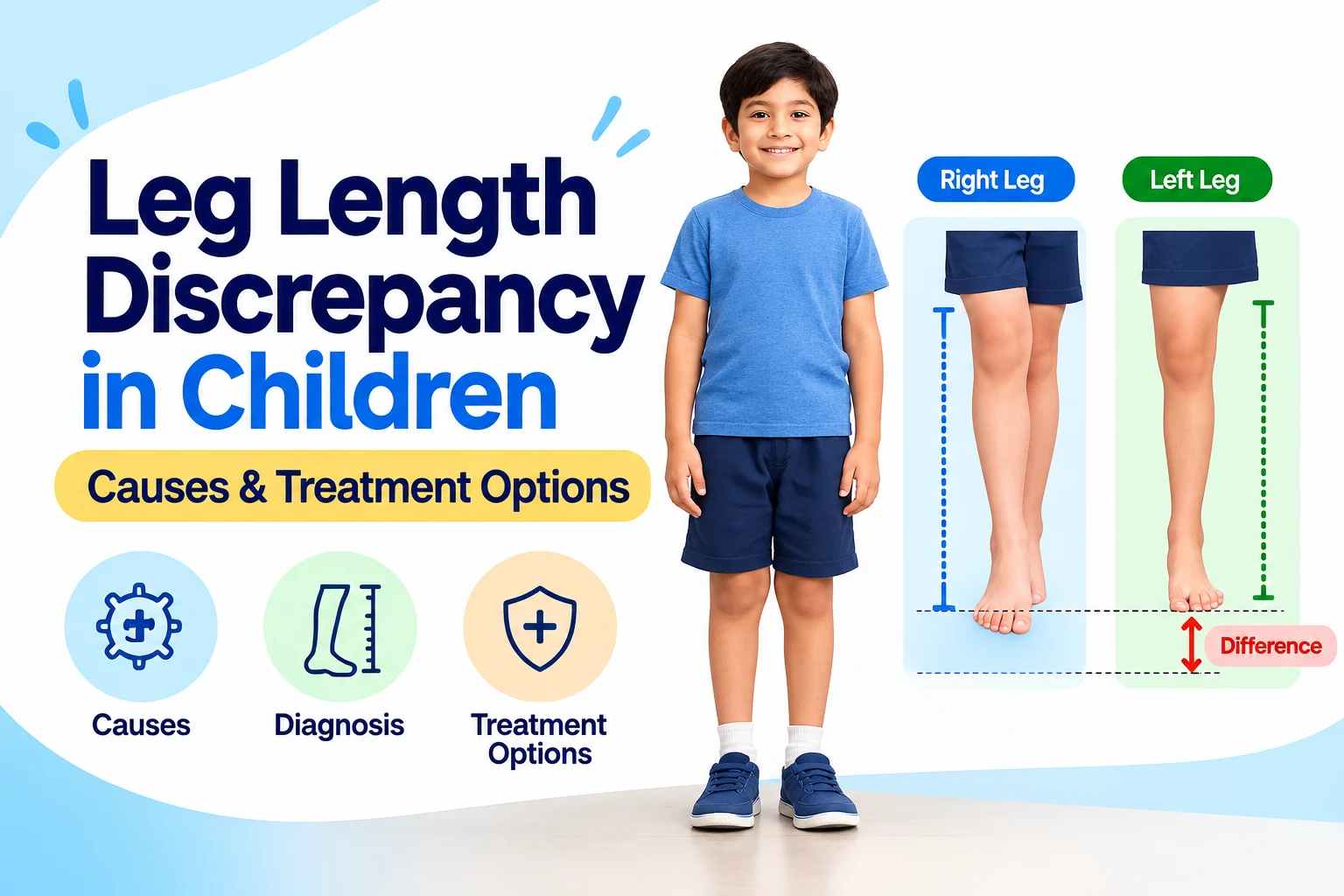
If you’ve noticed your child limping, standing with one hip higher than the other, or wearing down one shoe faster than the other, a leg length discrepancy could be the reason — and it’s far more common than most parents expect. About one in four people has a difference greater than one centimeter between their legs, though only around one in a thousand has a difference large enough (over two centimeters) to need active treatment.
Most parents come in worried they’ve missed something obvious. In reality, small discrepancies are often picked up first by a pediatrician during a routine check, or by a parent noticing an unusual walking pattern rather than any visible size difference.
What actually causes one leg to grow differently than the other?
There are two broad categories, and figuring out which one applies changes the whole treatment conversation.
Congenital causes — present from birth, even if not obvious until later:
- Underdevelopment of one of the bones between the knee and ankle (or knee and hip)
- Hemihypertrophy or hemiatrophy, where one entire side of the body grows larger or smaller than the other
- Certain hip conditions present from birth
Acquired causes — developing after birth, often from:
- A fracture that affected the growth plate, either directly damaging it or, less intuitively, sometimes stimulating extra growth in that leg
- Infection in the bone (osteomyelitis) that affects the nearby growth plate — this is one of the more serious causes and needs prompt treatment of the infection itself, which we cover in our article on bone and joint infection
- Conditions like juvenile arthritis that cause inflammation around a growing joint
- Neurological conditions affecting muscle use and, indirectly, bone growth on one side
In a meaningful number of cases, particularly milder ones, no clear cause is ever identified — doctors call this idiopathic, and it doesn’t mean anything was missed, just that growth doesn’t always follow a perfectly symmetrical pattern.
How do you actually know if it’s a discrepancy and not just how your child walks?
A few signs are worth paying attention to rather than dismissing as a phase:
- A visible limp, especially one that’s been consistent for weeks rather than appearing once after a fall
- Standing with one hip noticeably higher, or one knee held slightly bent to compensate
- Toe-walking on one side only
- Getting tired more quickly than other kids during play — compensating for uneven legs takes real extra effort
- One pant leg consistently needing to be hemmed shorter, or one shoe wearing out faster
None of these alone confirms a discrepancy, but a pattern of two or more is worth a proper evaluation.
How is leg length discrepancy diagnosed?
The process is straightforward and not uncomfortable for children. It typically starts with watching how your child stands, sits, and walks, followed by physical measurement of both legs. For a precise reading, we use a specific type of X-ray (a scanogram) that measures the exact length of each bone segment rather than relying on external measurement alone, which can be thrown off by muscle bulk or posture.
Does every discrepancy need treatment?
No — and this is worth saying clearly, because I see parents assume any measurable difference means surgery is coming. It doesn’t.
Small differences (roughly under 2 cm) are usually well tolerated and often don’t need any active treatment at all. Occasionally, a simple shoe lift is enough to even out the hips and prevent any compensatory strain.
Moderate to larger differences are where treatment decisions get more involved, and they depend heavily on how much growth the child has left. A discrepancy that seems significant in an eight-year-old may respond very differently to treatment than the same discrepancy noticed in a fourteen-year-old who’s nearly done growing.
Treatment options for more significant discrepancies
Growth modulation (epiphysiodesis). For children with enough remaining growth, this procedure slows or temporarily stops growth at the growth plate of the longer leg, allowing the shorter leg to catch up naturally over time. It’s less invasive than lengthening surgery but only works within a specific window before growth plates close.
Limb lengthening. When the discrepancy is too large for growth modulation to fully correct, or when the child is closer to skeletal maturity, lengthening the shorter leg becomes the better option. This can be done using an external frame (see our detailed explainer on the Ilizarov method) or, in suitable cases, an internal lengthening nail.
Limb shortening. Less commonly used, this involves removing a small segment of bone from the longer leg — typically only considered for smaller discrepancies in patients who’ve finished growing, since it permanently reduces the leg’s total length.
Orthotic management. A shoe lift or insert remains a genuinely valid long-term solution for many mild-to-moderate cases, particularly when surgery’s risks would outweigh the functional benefit for a small difference.
Why timing matters so much in children
This is the one point I try to make sure every parent leaves the appointment understanding: children are still growing, which is both the complication and the opportunity. A treatment plan has to account for how much growth remains, not just the current measurement — get the timing wrong, and a discrepancy that could’ve been corrected with a simple growth-plate procedure at age nine might need a full lengthening surgery by age thirteen. This is exactly why an early evaluation, even for a discrepancy that seems minor right now, is worth doing rather than adopting a “wait and see” approach indefinitely.
FAQ
Is it normal for kids to have slightly different leg lengths?
Yes, to a small degree. Most people — children included — have a barely measurable natural asymmetry. It only becomes a concern when the difference is large enough to affect walking, posture, or cause visible compensation.
Will my child need surgery for a leg length discrepancy?
Not necessarily. Many mild-to-moderate cases are managed successfully with a shoe lift or through growth modulation, which is far less invasive than full lengthening surgery. Surgery is generally reserved for larger discrepancies.
At what age should a leg length discrepancy be evaluated?
As soon as it’s noticed — the earlier a discrepancy is assessed, the more treatment options remain available, since some approaches only work while the child still has significant growth left.
Can a leg length discrepancy get worse over time?
It can, particularly if the underlying cause (like a growth plate injury or ongoing infection) is still active. This is part of why periodic monitoring matters even for discrepancies that don’t need immediate treatment.
Does limb lengthening surgery affect a child’s other physical activities long-term?
Most children return to full activity, including sports, after completing treatment and recovery. The timeline for return to sport depends on the specific method used and the amount of correction needed.
Reviewed by Dr. Tanay Goyal, Orthopaedic Surgeon specializing in deformity correction and limb lengthening, Sankalp Multi-Specialty Hospital, Ambikapur. If you’ve noticed a limp or uneven leg length in your child, book an appointment or read more about our deformity correction and limb lengthening program.