
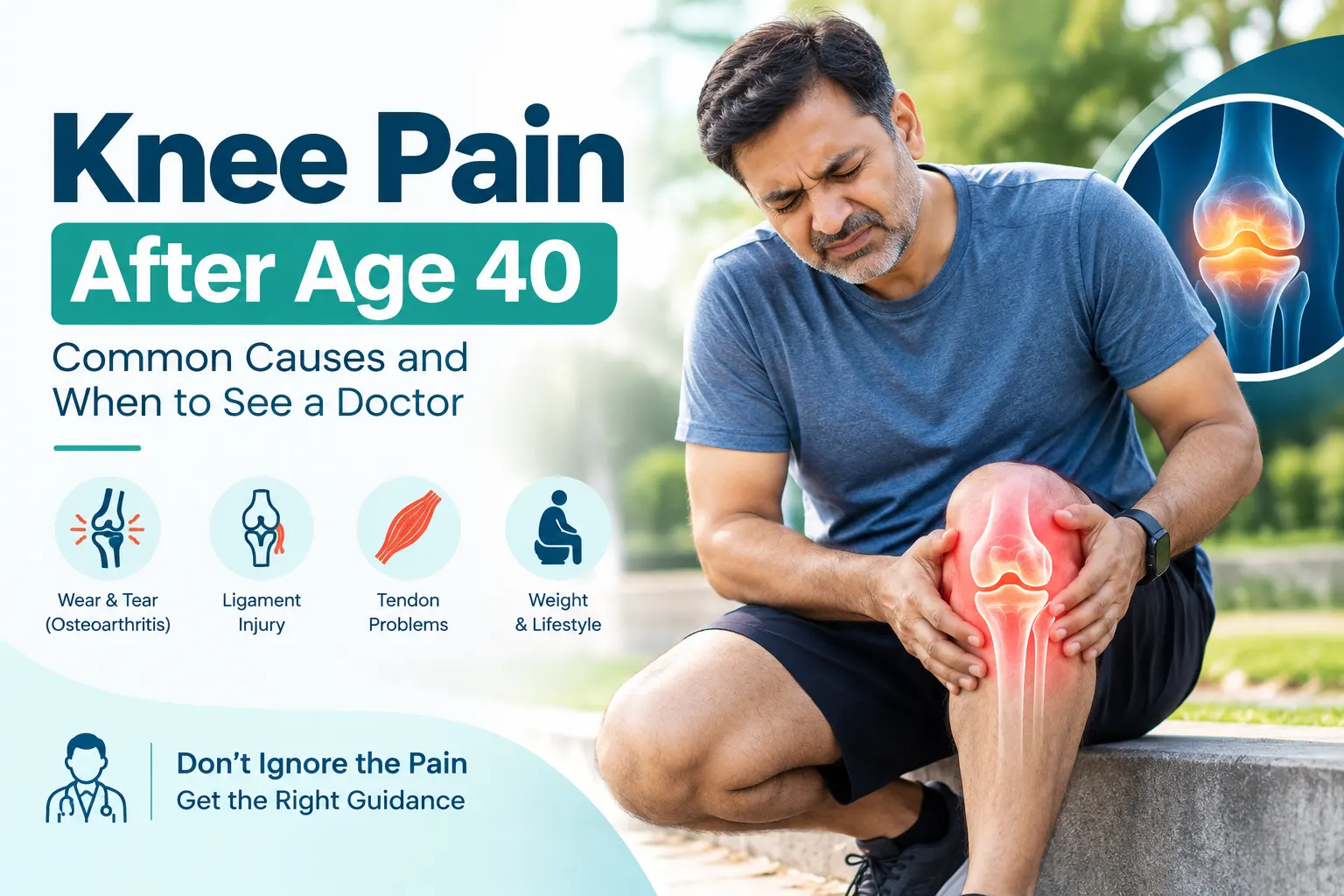
Knee pain that shows up after 40 usually falls into one of four buckets: early osteoarthritis, a meniscus wearing down rather than tearing suddenly, a ligament strain from an activity your knees aren’t used to anymore, or simple overuse from carrying extra weight or spending more time on your feet than usual. Most of it responds well to fairly simple changes — but a fair number of patients wait far longer than they should before getting it checked, assuming it’s just “part of getting older.”
It isn’t always, and even when it partly is, there’s usually something that can be done about it rather than just living with it.
The most common causes I actually see in the clinic
Osteoarthritis. This is the wear-and-tear breakdown of the cartilage that cushions your knee joint, and it’s genuinely more likely to start showing up after 40, though it varies a lot by individual. It typically causes stiffness that’s worse in the morning or after sitting for a while, along with a dull ache that builds with activity.
Meniscus wear or tear. The meniscus is the C-shaped cartilage cushion in your knee, and past 40 it doesn’t always take a dramatic injury to tear — sometimes just an awkward twist during an ordinary movement is enough, because the tissue has naturally become less resilient over time.
Ligament strain. Picking up a new sport, an intense trek, or even an unusually long day of walking can strain the ligaments around the knee, particularly if your activity level has been lower for a while beforehand.
Overuse and joint stress from weight. Extra body weight adds meaningful load to the knee joint with every step — even a modest amount of weight loss measurably reduces the stress on the joint, which is part of why it’s one of the first things addressed in long-term knee pain management.
Patellofemoral pain (kneecap-related pain). This shows up as pain around or under the kneecap, often worse going down stairs, and becomes more common in older adults as a result of arthritis affecting the kneecap’s tracking within its groove.
Signs your knee pain needs more than home care
Rest, ice, and modifying activity handle a lot of everyday knee pain. But get it checked rather than waiting it out if you notice:
- Marked swelling, redness, or warmth around the joint
- The knee feels unstable, or genuinely gives way when you put weight on it
- You can’t fully straighten or bend the knee
- Pain accompanied by fever — this combination can point to joint infection, which needs urgent attention
- Pain that’s persisted for more than a couple of weeks despite rest and basic self-care
- Pain that’s interfering with sleep or your normal daily activities
What actually helps at home, if it isn’t one of the warning signs above
For knee pain without those red flags, a few genuinely useful steps:
- Rest the joint — reduce high-impact activity, but don’t stop moving entirely; complete inactivity tends to make joint stiffness worse, not better
- Switch to low-impact movement — swimming or cycling instead of running keeps you active without the repeated joint impact
- Ice the knee for short periods to reduce swelling and discomfort
- Strengthen the muscles around the knee — particularly the quadriceps, since stronger surrounding muscles take real load off the joint itself
- Address excess weight if relevant — even a modest reduction meaningfully lightens the pressure on the knee joint with every step
When knee pain is arthritis — what changes about the treatment approach
If osteoarthritis turns out to be the underlying cause, the initial approach usually centers on exactly the self-care measures above — low-impact exercise and weight management genuinely help manage arthritis-related knee pain for a meaningful stretch of time. It’s only when these measures stop being enough — persistent pain that limits daily function despite consistent effort — that we start discussing options like joint injections or, for more advanced cases, knee replacement, which we cover in detail in our article on total knee replacement recovery.
FAQ
Is knee pain after 40 always a sign of arthritis?
No. Meniscus wear, ligament strain, overuse, and kneecap-related pain are all common at this age and aren’t the same thing as osteoarthritis, even though the symptoms can feel similar at first.
How long should I try home care before seeing a doctor?
A week or two of rest, ice, and activity modification is reasonable for pain with no warning signs. If it’s not improving by then, or if you notice swelling, instability, or pain that’s affecting your sleep, it’s worth getting evaluated rather than continuing to wait.
Does losing weight actually help knee pain, or is that oversimplified advice?
It genuinely helps — extra body weight adds real, measurable load to the knee joint with every step, and even a modest reduction can meaningfully ease arthritis-related knee pain. It’s one of the few pieces of general health advice that has direct, specific relevance to knee joint stress.
Can knee pain from a meniscus problem go away on its own?
Some minor meniscus wear settles with rest and strengthening exercises. A more significant tear, especially one causing locking or catching sensations in the knee, usually needs a proper evaluation rather than waiting it out indefinitely.
Should I stop exercising completely if my knee hurts?
Generally no — switching to low-impact activity like swimming or cycling keeps the joint moving and the surrounding muscles strong, both of which help rather than hurt most causes of knee pain. Complete rest is really only appropriate for acute injuries with clear warning signs.
Reviewed by Dr. Tanay Goyal, Orthopaedic Surgeon, Sankalp Multi-Specialty Hospital, Ambikapur, treating knee conditions from arthritis to ligament and meniscus injuries. If knee pain has been bothering you for more than a couple of weeks, book an appointment or read more about our knee and hip replacement services.