
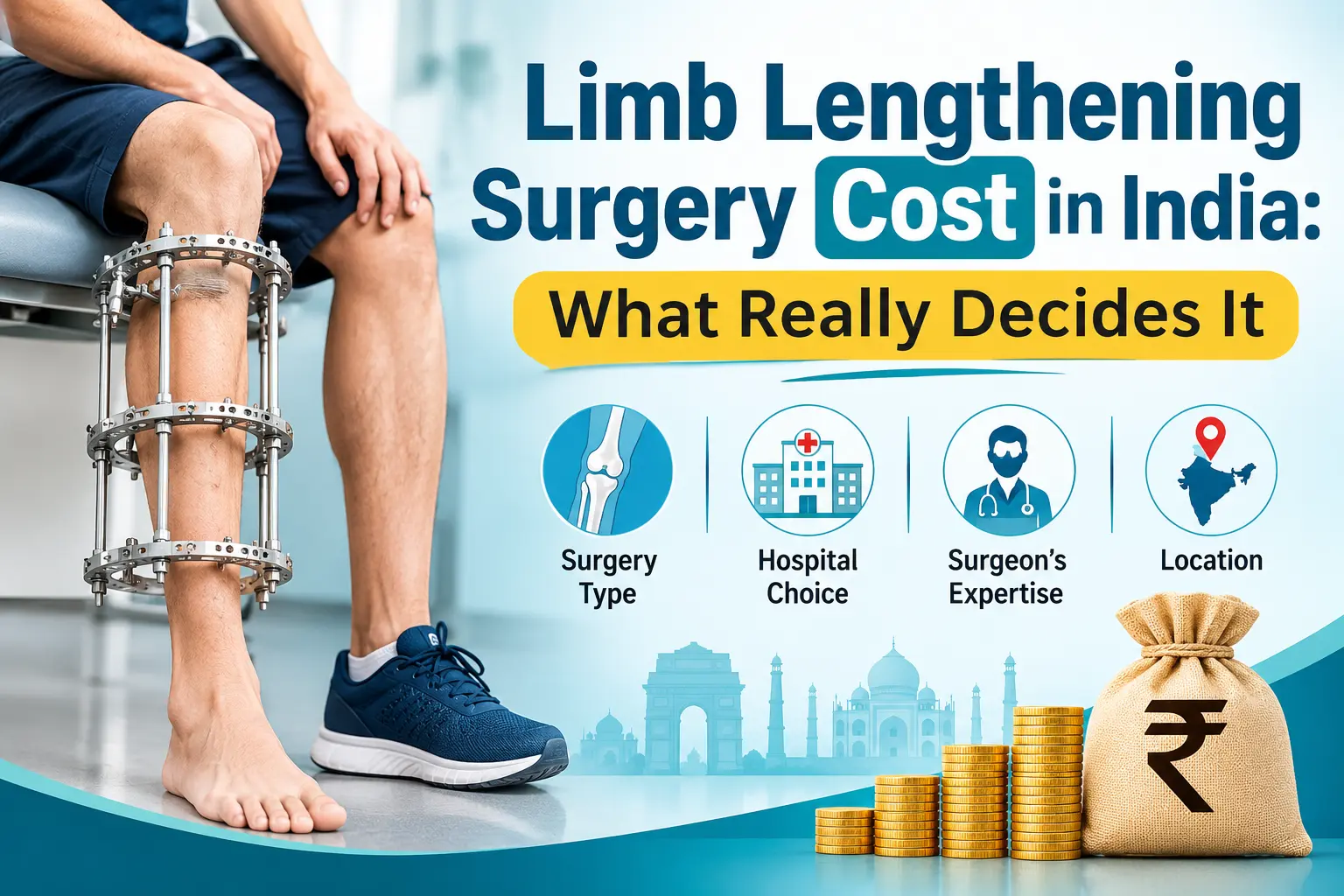
There’s no single number for limb lengthening surgery cost in India, because the price depends almost entirely on which method is used, how much correction is needed, and the hospital stay involved. Industry estimates put the broad range anywhere from roughly ₹1.5 lakh to well over ₹50 lakh — a gap wide enough that quoting a flat figure would honestly be misleading. What matters more than any single number is understanding what actually drives the cost up or down, so you can ask the right questions when you’re getting a quote.
I’ll be upfront about something most cost articles skip: exact pricing should come directly from your treating hospital based on your specific case, not from a general blog post. What I can walk you through here are the real factors that explain why one patient’s quote looks completely different from another’s for what seems, on the surface, like a similar condition.
The method used is the single biggest cost driver
The Ilizarov method — an external ring frame, explained in detail in our Ilizarov method guide — is generally the most cost-effective surgical option for limb lengthening and deformity correction. It requires more hands-on follow-up (regular frame adjustments and pin-site care) but avoids the cost of the more advanced implant hardware.
Lengthening Over Nail (LON) combines an external frame with an internal rod, reducing the time the external frame needs to stay on. It typically costs more than a standalone Ilizarov frame because it uses both external and internal hardware.
Motorized internal nails (like PRECICE-type systems) are magnetically controlled rods placed entirely inside the bone, adjusted externally with a remote device — no visible external frame at all. These are considerably more comfortable day to day but carry a significantly higher cost, largely driven by the price of the implant itself, which is imported technology.
As a rough sense of scale reported across Indian providers, standard Ilizarov-based treatment often falls in a noticeably lower bracket than motorized nail systems, where implant cost alone can run into several lakhs per leg. The gap between these options is large enough that it’s worth discussing directly with your surgeon which method actually fits your specific correction — not just which one costs less.
What else affects the final number
How much correction is needed. A minor leg length discrepancy requiring a small amount of lengthening costs considerably less than major deformity correction or lengthening involving both bones of the leg.
Whether it’s one limb or both. Bilateral procedures (both legs) obviously cost more than a single limb, though some of the hospital and anesthesia costs don’t simply double, since certain fixed costs are shared across both sides.
Length of hospital stay. Complex cases requiring closer monitoring or staged surgery naturally involve more inpatient days, which adds to the total.
Whether infection is part of the picture. If limb lengthening is being combined with treatment for an underlying bone infection — which we cover in our article on bone and joint infection — the cost structure changes meaningfully, since it typically involves staged surgery, extended antibiotic treatment, and closer follow-up than a straightforward lengthening case.
City and hospital type. Costs in metropolitan private hospitals tend to run higher than in smaller cities, partly reflecting overhead costs rather than any difference in surgical outcome.
Post-operative physiotherapy and follow-up visits. This is the cost component people forget to budget for. Physical therapy through the recovery period, and the regular follow-up visits needed to monitor bone healing (particularly with external fixation methods), add up over the months of treatment and aren’t always included in an initial quoted figure.
Why “cheapest option” isn’t the right question to start with
It’s tempting to shop for the lowest quoted price, particularly given how wide the range is. But the more useful starting question is which method is actually appropriate for your specific condition — a straightforward leg length discrepancy and a complex post-infection bone defect aren’t comparable cases, even if a generic cost article lists them under the same procedure name. The right question for your consultation is: given my specific diagnosis, which method does the surgeon recommend, and why that one over the alternatives?
Questions worth asking during your consultation
- Which method is being recommended for my specific case, and why not the alternative options?
- What’s included in the quoted cost — surgery, implant, hospital stay, physiotherapy, follow-up visits — and what isn’t?
- How many follow-up visits are typically needed, and over what total treatment period?
- What’s the realistic total timeline, including the recovery and consolidation phase, not just the surgery date?
- For international patients: what does the full package look like including accommodation and travel logistics? Our international patients page covers what’s typically involved in planning treatment from outside India.
FAQ
Is the Ilizarov method always cheaper than motorized nail systems?
In most cases, yes — the Ilizarov frame avoids the cost of expensive imported implant hardware, though it requires more frequent follow-up visits and hands-on frame management during treatment.
Does insurance typically cover limb lengthening surgery in India?
Coverage varies considerably by policy and by whether the procedure is being done for a medical reason (correcting a genuine deformity or discrepancy) versus purely elective height increase, which insurers generally don’t cover. Check directly with your insurer using the specific diagnosis code your surgeon provides.
Why do some quotes for the same procedure vary so much between hospitals?
Differences usually come down to which method is being proposed, what’s included in the quoted figure (some quotes bundle physiotherapy and follow-up, others don’t), and genuine differences in hospital overhead between cities and facility types.
Is a lower-cost option necessarily lower quality?
Not automatically — cost differences often reflect the method and hospital type rather than surgical skill. That said, this is exactly why understanding which method fits your specific case matters more than comparing prices for what might not actually be comparable treatments.
How much of the total cost is the physiotherapy and follow-up, versus the surgery itself?
This varies by case, but for methods requiring an external frame worn over several months, follow-up visits and physiotherapy can represent a meaningful portion of the total cost — which is exactly why it’s worth asking for a full treatment-period estimate rather than just the initial surgical quote.
Reviewed by Dr. Tanay Goyal, Orthopaedic Surgeon specializing in deformity correction and limb lengthening, Sankalp Multi-Specialty Hospital, Ambikapur. For an accurate, personalized cost estimate based on your specific condition, book a consultation or read more about our deformity correction and limb lengthening program.