
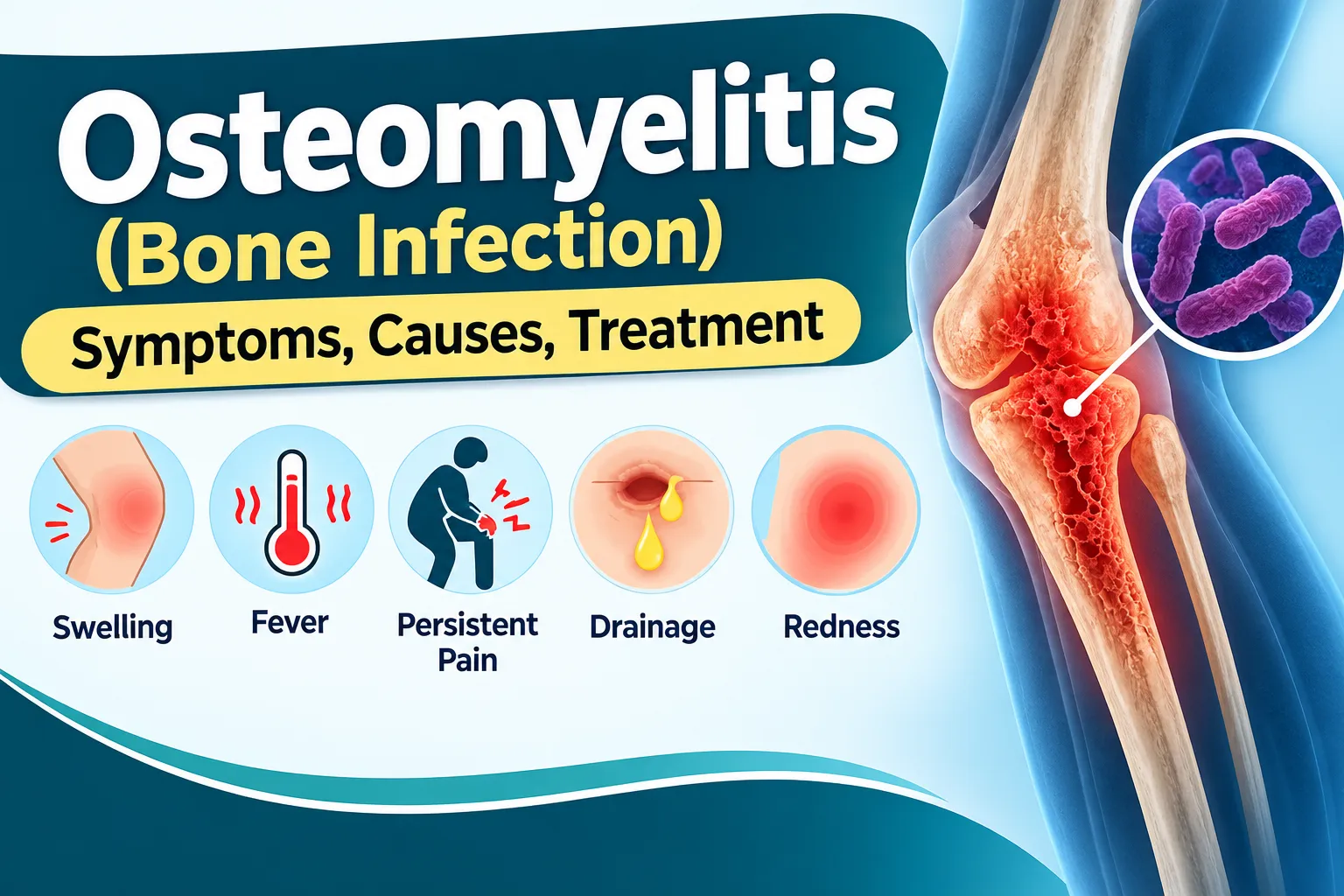
Osteomyelitis is a bone infection, usually caused by bacteria, that can settle into a bone and — if not treated properly — slowly damage it from the inside. Most cases start elsewhere in the body: a skin wound, a urinary infection, even pneumonia, with bacteria eventually traveling through the bloodstream and settling in a weakened spot in the bone. The other common route is more direct — bacteria entering through an open fracture, a surgical wound, or a deep puncture injury.
What makes osteomyelitis tricky, in my experience, is how quietly it can announce itself. Some patients show up with an obviously swollen, hot, red limb and a fever. Others come in months after what seemed like a routine fracture surgery, with nothing more than a persistent dull ache they assumed was normal healing pain.
How does a bone actually get infected?
There are three main pathways:
Through the bloodstream. Bacteria from an infection elsewhere in the body — a skin infection, a UTI, even a dental infection in some cases — travel through the blood and settle in bone, particularly in areas with reduced blood flow or recent injury. This route is more common in children, where the growth plates in long bones (arms and legs) have a rich blood supply that can act almost like a magnet for circulating bacteria.
Through direct contamination. Open fractures, deep puncture wounds, or bone surgery all create a direct path for bacteria to reach the bone. This is why open fractures are treated as urgent — the exposed bone has essentially no barrier against infection until it’s surgically cleaned and closed.
Spreading from nearby infected tissue. An infected wound, ulcer, or soft tissue infection right next to a bone can spread into it over time. This is a particularly common issue in patients with diabetes who develop foot ulcers — the infection can work its way into the underlying bone if the ulcer isn’t managed early.
Warning signs that shouldn’t be ignored
Symptoms vary depending on whether the infection is acute (recent, sudden onset) or chronic (long-standing, sometimes following an old injury or surgery). Watch for:
- Persistent, deep bone pain that doesn’t match the severity of any visible injury
- Swelling, warmth, and redness over the affected area
- Fever, chills, and general fatigue
- In open wounds or surgical sites: drainage, especially if it has an unusual odor or the wound simply won’t close properly
- In children particularly: irritability, reduced use of a limb, or refusal to bear weight, sometimes without an obvious fever
One pattern worth flagging specifically: if you’ve had a fracture treated with plates, screws, or rods, and the surgical site develops ongoing pain, swelling, or drainage weeks or months after surgery — well past the normal recovery window — that combination points toward infection, not routine healing discomfort.
Who’s at higher risk?
Certain factors make osteomyelitis more likely or harder to fight off once it starts:
- Diabetes, particularly with foot ulcers
- Smoking, which reduces blood flow needed to fight infection
- A weakened immune system, from illness or certain medications
- Poor circulation, from vascular disease or other causes
- Recent bone surgery, especially where metal implants were placed
- Open fractures or deep puncture wounds
- Kidney failure requiring dialysis
How is osteomyelitis diagnosed?
Diagnosis usually combines several pieces of information rather than relying on any single test:
- Blood tests to check inflammatory markers (ESR, CRP) and look for signs of active infection
- Imaging — X-rays first, though early infection often doesn’t show up clearly; MRI is considerably more sensitive for catching bone infection in its earlier stages
- Bone biopsy in many cases, to identify exactly which bacteria are involved — this matters because it determines which antibiotic will actually work, rather than treating with a broad-spectrum guess
How osteomyelitis is treated
This is where I want to set realistic expectations, because osteomyelitis treatment is rarely a quick course of antibiotics and done.
Antibiotics, usually for an extended period. Depending on severity, this can mean several weeks of intravenous antibiotics, sometimes followed by an extended oral course. The specific antibiotic is chosen based on which bacteria the biopsy identifies — Staphylococcus is the most common culprit, but not the only one.
Surgical removal of infected and dead bone (debridement). In many cases, especially chronic osteomyelitis, antibiotics alone can’t reach and clear infection that’s settled into bone tissue with reduced blood supply. Surgically removing the infected portion is often what actually gets ahead of the infection, with antibiotics then finishing the job.
Reconstruction after debridement. Removing infected bone sometimes leaves a real structural gap, particularly in chronic cases that have gone untreated for a while. This is where techniques like external fixation and staged bone reconstruction come in — we go into this in detail in our articles on limb salvage and limb reconstruction after infection.
Managing any underlying condition. If diabetes or poor circulation contributed to the infection taking hold, treating those factors alongside the bone infection itself significantly affects how well treatment works long-term.
Can osteomyelitis come back after treatment?
Yes, particularly chronic osteomyelitis, which has a genuine tendency to resurface even after what looks like successful treatment — sometimes years later. This is why follow-up after treatment matters as much as the initial treatment itself, and why we don’t consider a case fully closed just because symptoms have resolved and antibiotics are finished.
FAQ
Can osteomyelitis be cured completely?
Acute osteomyelitis, caught and treated early, generally has a good outcome with antibiotics and, when needed, surgical debridement. Chronic osteomyelitis is more stubborn and can require multiple rounds of treatment, though long-term control and functional limb salvage are realistic goals even in difficult cases.
Does osteomyelitis always cause a fever?
No — chronic osteomyelitis in particular can exist with minimal or no fever, especially in adults. Persistent localized pain or drainage from an old surgical or injury site is sometimes the only clue.
Is osteomyelitis contagious?
No, you can’t catch osteomyelitis from another person the way you would a cold. The bacteria involved typically come from a person’s own skin flora or from a wound getting contaminated, not from person-to-person spread.
Can a bone infection lead to amputation?
In severe, long-neglected cases — particularly with poor circulation or uncontrolled diabetes — amputation can become necessary if the infection can’t be controlled by other means. This is exactly why early treatment matters so much; most osteomyelitis caught reasonably early can be managed with limb-salvage approaches rather than amputation.
How long does osteomyelitis treatment typically take?
Acute cases might resolve within four to six weeks of targeted antibiotic treatment. Chronic osteomyelitis, particularly when surgical reconstruction is needed, can realistically take several months to over a year for complete resolution and bone healing.
Reviewed by Dr. Tanay Goyal, Orthopaedic Surgeon specializing in bone and joint infection management, Sankalp Multi-Specialty Hospital, Ambikapur. If you have persistent pain, swelling, or drainage near an old fracture or surgical site, don’t wait for it to resolve on its own — book an appointment or read more about our bone and joint infection treatment.