
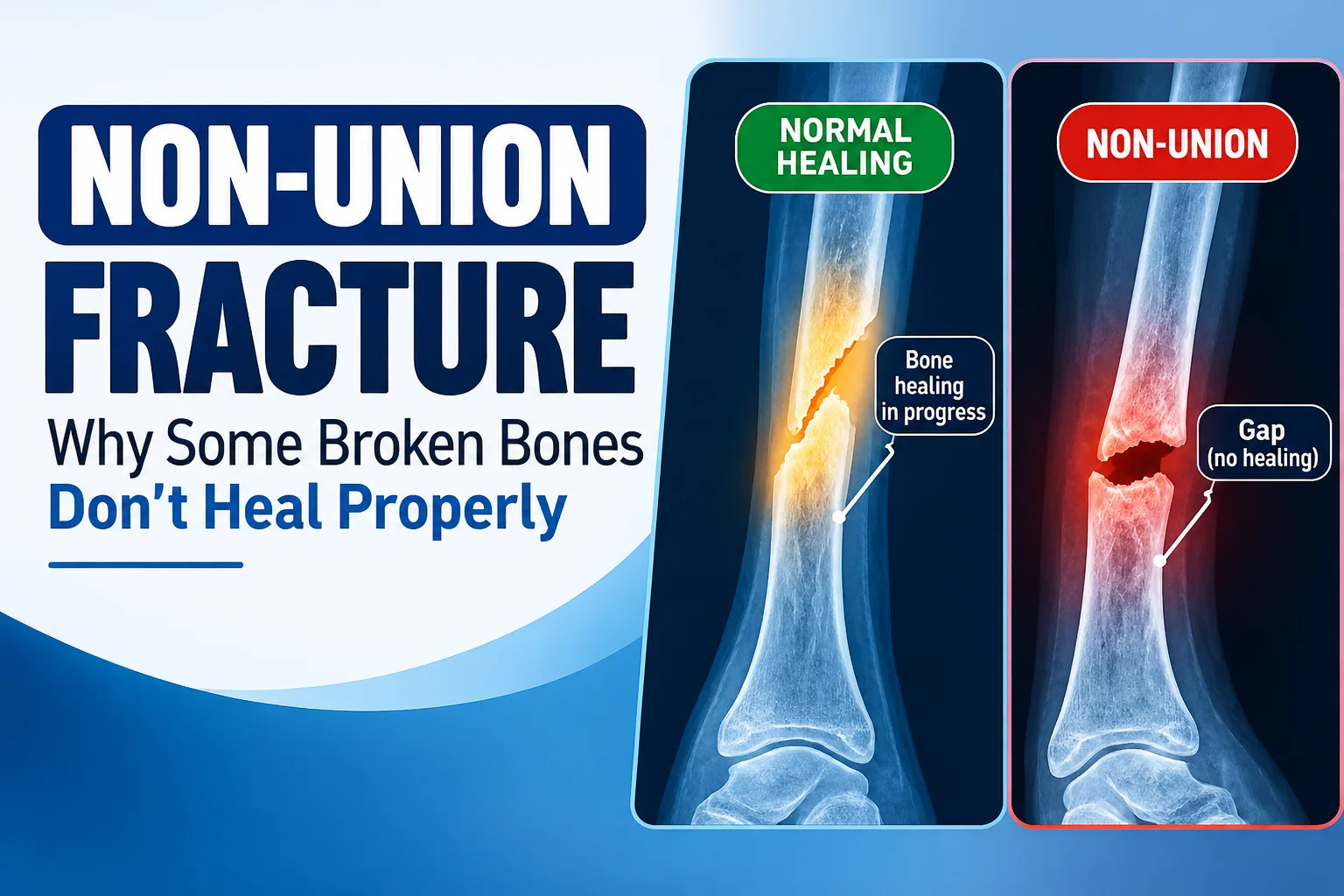
A non-union fracture is a broken bone that has stopped trying to heal — not one that’s simply taking longer than usual. By the widely used FDA definition, a fracture is called a non-union once it’s at least nine months old and has shown no sign of new bone growth on X-ray for three consecutive months. If you’re past the six-month mark and still in pain at the fracture site, it’s worth getting checked rather than waiting it out.
Most fractures don’t behave this way. Put a broken bone in a cast or fix it with a plate and screws, and the body typically does the rest — new bone tissue called callus bridges the gap over several weeks. What surprises a lot of patients is finding out that healing can simply stall, sometimes for reasons that have nothing to do with how well the original treatment was done.
Delayed union vs. non-union — they’re not the same thing
These two terms get used interchangeably, and that’s a mistake. A delayed union means the fracture is healing, just more slowly than the typical timeline for that bone. A non-union means healing has stopped entirely — the gap isn’t closing, and left alone, it likely never will. Telling the two apart matters because a delayed union may only need more time and support, while a non-union usually needs a change in treatment approach.
Why does a fracture stop healing?
There isn’t one single cause. In my clinic, the non-unions I see tend to fall into a handful of recurring patterns:
- Poor blood supply at the fracture site. Bones like the shinbone (tibia) and the scaphoid in the wrist have naturally limited blood flow in certain segments. A high-energy injury — a road accident, for instance — can damage what little blood supply exists.
- Too much movement at the fracture site during healing. Bone needs relative stability to bridge a gap. If a cast loosens, or internal fixation wasn’t stable enough for the fracture pattern, the healing bone gets disrupted repeatedly and never consolidates.
- Infection at the fracture site. An infected fracture — especially with open fractures — can actively prevent healing. This overlaps closely with what we treat under bone and joint infection.
- Smoking. This one surprises people, but nicotine measurably restricts blood flow to healing bone. It’s one of the most modifiable risk factors for non-union, and I bring it up with every smoker who comes in with a slow-healing fracture.
- Diabetes and poor nutrition. Uncontrolled blood sugar and inadequate protein, calcium, and vitamin D intake all slow bone formation.
- A large gap between bone fragments. If the original fracture displaced significantly, or if bone was lost in the injury itself (common in high-energy trauma), there may simply be too much distance for new bone to bridge on its own.
What does a non-union actually feel like?
The pain pattern is what usually tips people off, according to OrthoInfo from the American Academy of Orthopaedic Surgeons: pain at the fracture site that persists well past the point where the initial injury pain should have faded — sometimes for months, sometimes years. It might be constant, or it might only flare up when you put weight on the limb or use it actively. Some patients also notice the limb feels unstable or “gives way,” which suggests the bone still isn’t providing structural support.
How is a non-union diagnosed?
Usually it starts with a simple observation: an X-ray taken at a routine follow-up shows no visible progress compared to the scan from a few weeks earlier. From there, we typically look at:
- Repeat X-rays over time to confirm the absence of healing progress, rather than relying on a single image
- CT scans in some cases, for a more detailed look at whether any bone bridging exists
- Blood tests, especially if infection is suspected — markers like ESR and CRP can flag a smoldering infection at the fracture site
- A review of your medical history — smoking, diabetes, medications, and the mechanism of the original injury all factor into figuring out why healing stalled
Treatment options for non-union fractures
There’s no single fix — the right approach depends on why the bone stopped healing in the first place.
Revision surgery with better fixation. If the original stabilization wasn’t rigid enough, switching to a stronger construct — a locking plate, an intramedullary nail, or in more complex cases, an external fixator — can restart the healing process by finally giving the bone the stability it needs.
Bone grafting. This involves adding bone tissue, either taken from another part of your own body (commonly the hip) or from a donor source, directly at the non-union site to stimulate new bone formation.
Treating any underlying infection first. If infection is part of the picture, healing the bone and clearing the infection often have to happen together — sometimes with staged surgery rather than a single operation.
Distraction osteogenesis for larger defects. For non-unions with significant bone loss, techniques using external fixation to gradually generate new bone can succeed where a straightforward graft wouldn’t be enough. We go into how this actually works in our article on the Ilizarov method.
Addressing modifiable risk factors. Quitting smoking, getting diabetes under proper control, and correcting nutritional deficiencies genuinely change outcomes here — it’s not just general health advice tacked onto the treatment plan.
The honest timeline
Non-union treatment isn’t quick. Depending on the method used, you’re typically looking at anywhere from four months to over a year before the bone is fully consolidated, and that’s on top of however long you’d already been dealing with the original fracture. What I tell patients is this: the goal isn’t speed, it’s getting the bone to a state where it’s genuinely solid — a second failed attempt costs far more time than doing it right the first time.
FAQ
How long does a fracture need to go without healing before it’s officially a non-union?
The commonly used clinical threshold is nine months since injury, with no radiographic healing progress for the last three consecutive months. In practice, if there’s clearly no improvement by six months, it’s worth a specialist review rather than waiting for the nine-month mark.
Can a non-union fracture heal on its own without surgery?
Occasionally, if the cause is mechanical (not enough stability) and that’s corrected with a better brace or cast, some delayed unions do progress. A true non-union, though, usually needs intervention — the biological process has essentially stopped and typically won’t restart without a change in treatment.
Is a non-union fracture more common in certain bones?
Yes. The tibia (shinbone), scaphoid (a small wrist bone), and femoral neck (upper thighbone) are more prone to non-union because of their naturally limited blood supply.
Does smoking really make that much of a difference to fracture healing?
It does — nicotine constricts blood vessels and measurably reduces the blood flow bone needs to heal. Patients who quit smoking during non-union treatment tend to show better healing response than those who continue.
Will I need multiple surgeries to fix a non-union?
Not always. A straightforward non-union with good bone quality might heal with a single revision surgery and bone grafting. More complex cases — especially with infection or significant bone loss — sometimes need a staged approach over several procedures.
Reviewed by Dr. Tanay Goyal, Orthopaedic & Trauma Surgeon, Sankalp Multi-Specialty Hospital, Ambikapur, specializing in complex and failed fracture care. If your fracture isn’t healing on schedule, don’t wait it out — book an appointment or read more about our failed fracture treatment approach.