
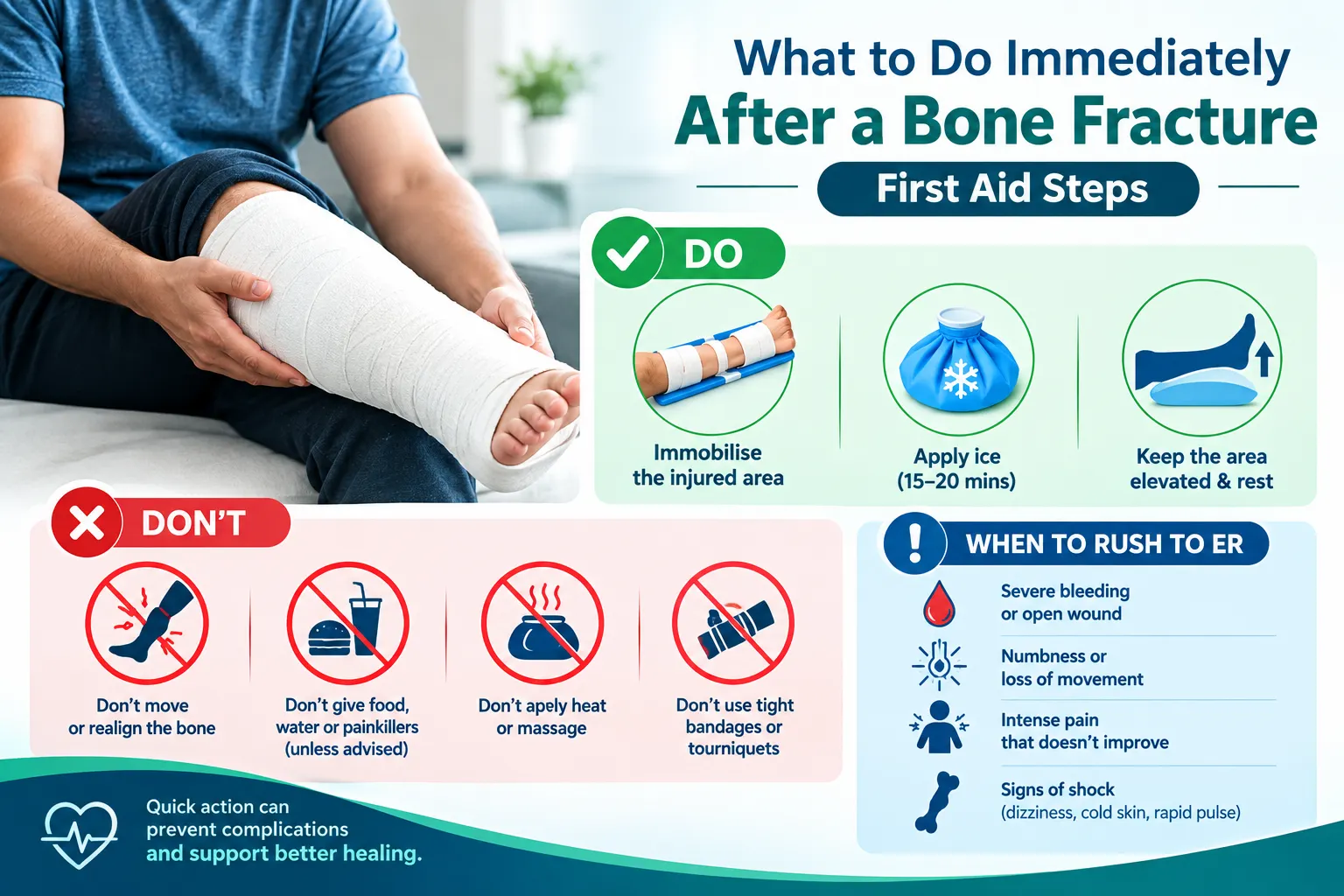
If you suspect a bone is broken, do three things right away: keep the injured limb still, support it above and below the break without trying to straighten it, and get to a doctor or emergency room instead of waiting to see if the swelling goes down. What you do — or don’t do — in the first ten minutes after a fracture often decides how smoothly the bone heals later.
I see this pattern often in the emergency room at Sankalp Hospital: someone falls off a bike, or a child comes off the school playground equipment, and a well-meaning relative tries to “test” whether the arm is broken by moving it around. That’s usually the moment a clean, simple fracture turns into one with displaced bone ends, which is harder to set and takes longer to heal.
How do you know if a bone is actually broken?
You can’t always tell just by looking. A bad sprain and a fracture can feel almost identical in the first hour. That said, a few signs point more strongly toward a break:
- The limb looks bent, twisted, or shaped differently than the other side
- You heard or felt a snap or grinding sound at the moment of injury
- The pain is sharp and localized to one spot, rather than a general ache
- There’s swelling that comes on fast — within the first 20–30 minutes
- The person can’t put any weight on it, or can’t use the limb at all
If you’re not sure, treat it as a fracture. An X-ray in the ER costs you twenty minutes. Walking around on a broken bone for two days before getting it checked can cost you weeks.
Step-by-step: what to do in the first few minutes
1. Stop what’s causing the injury and keep the person still. Don’t try to get up and “walk it off.” Movement is exactly what displaces a fracture that might otherwise stay in a manageable position.
2. Don’t try to straighten or realign the limb. This is the single biggest mistake I see. Even if the limb looks obviously bent, leave it in the position you found it. Trying to straighten it yourself can tear surrounding muscle, nerves, or blood vessels that were otherwise undamaged.
3. Support the limb above and below the injury. Use a rolled-up towel, a magazine, a piece of wood — anything rigid — as an improvised splint. The goal is just to stop the injured section from moving, not to fix it in place permanently. Mayo Clinic’s first aid guide recommends padding the splint on both sides so it doesn’t press directly into the skin.
4. If the bone has broken through the skin, don’t push it back in. Cover the wound with a clean cloth and apply gentle pressure to control bleeding. An open fracture needs antibiotics and surgical cleaning quickly — this is one situation where “the sooner, the better” genuinely applies, since exposed bone has a real infection risk.
5. Apply ice, but not directly on the skin. Wrap ice in a cloth or towel. This helps with pain and swelling but won’t do anything for the fracture itself.
6. Get to an emergency room — don’t wait it out at home. This is where a lot of people in and around Ambikapur lose time. A fracture doesn’t need to look dramatic to need urgent attention. Hairline fractures in particular can look almost normal on the outside while still needing a cast or, in some cases, surgical fixation.
When it’s a genuine emergency — call for help, don’t drive yourself
Go straight to emergency care, or call for an ambulance, if any of the following apply:
- The limb or joint looks visibly deformed
- The skin over the injury has turned pale, blue, or cold — this can mean the blood supply is affected
- There’s heavy bleeding that doesn’t stop with direct pressure
- You suspect a fracture in the neck, back, hip, or pelvis — in these cases, don’t move the person at all unless there’s immediate danger
- The person is confused, unresponsive, or in shock (cold, clammy skin; rapid breathing)
What happens once you reach the hospital
At Sankalp Multi-Specialty Hospital, our 24/7 emergency orthopedic care team starts with an X-ray to confirm the fracture pattern — whether it’s a clean break, a hairline crack, or a more complex fracture with multiple fragments. Most straightforward fractures are treated with a cast or splint. More complex ones, especially those involving joints or multiple bone fragments, may need surgical fixation with plates, screws, or rods.
One thing worth knowing: not every fracture heals on the first attempt, even with correct treatment. If pain persists well beyond the usual healing window, or an X-ray shows no visible progress months later, that’s a different situation — one we cover in detail in our article on non-union fractures.
FAQ
Should I give the person painkillers before reaching the hospital?
A basic over-the-counter painkiller like paracetamol is generally fine. Avoid anything that could increase bleeding risk (like aspirin or ibuprofen) until you’ve been seen by a doctor, especially if surgery might be needed.
Can I still move the injured area a little to check if it’s really broken?
No — resist this urge, even out of curiosity. Movement is what turns a simple, non-displaced fracture into one that needs surgery to realign.
How soon after a fracture does swelling start?
Usually within the first 30 minutes to a few hours. Fast, significant swelling is actually one of the signs that points toward a fracture rather than a mild sprain.
Is it normal for a hairline fracture to have almost no swelling?
Yes. Hairline (stress) fractures often look deceptively mild — no obvious deformity, mild swelling — which is exactly why they get missed if you don’t get an X-ray.
What if the child seems fine and is walking on the leg a bit?
Children sometimes continue bearing weight on a fractured limb, especially with greenstick fractures (a partial break common in growing bones). “Walking on it” is not proof that nothing is broken — if there was a fall or direct impact followed by ongoing pain, get it checked.
Reviewed by Dr. Tanay Goyal, Orthopaedic & Trauma Surgeon, Sankalp Multi-Specialty Hospital, Ambikapur. If you’re dealing with a recent fracture or an old one that isn’t healing right, book an appointment or read more about our approach to complex fracture care.