
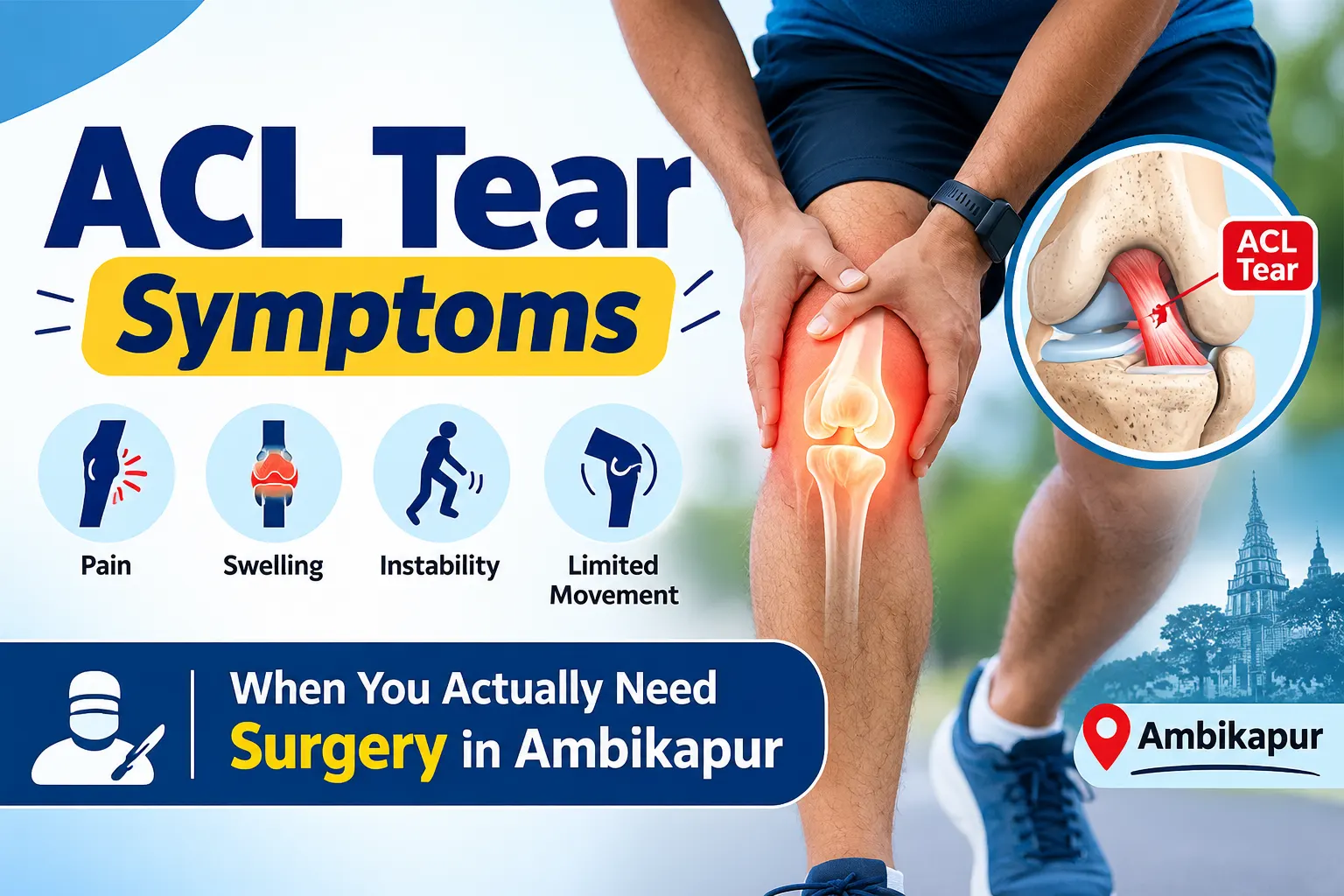
If you heard or felt a pop in your knee during sport, followed by rapid swelling and a feeling that your knee “gives way” when you try to stand on it, there’s a real chance you’ve torn your ACL — the anterior cruciate ligament that keeps your knee stable during pivoting and quick direction changes. Not every ACL tear needs surgery, but every ACL tear needs an accurate diagnosis, because untreated instability tends to cause secondary damage to other parts of the knee over time.
The ACL is one of the most commonly injured knee ligaments, and it affects more than just athletes. I see it in football players and runners, but also in people who twisted awkwardly getting off a bus, or missed a step coming down stairs. About half of ACL injuries occur alongside damage to the meniscus or other knee ligaments, which is part of why a proper examination matters more than trying to self-diagnose based on symptoms alone.
What does an ACL tear actually feel like?
The classic presentation includes:
- A distinct popping sound or sensation at the moment of injury
- Rapid swelling, usually within the first few hours
- Significant pain, though some people describe surprisingly little pain immediately after, with the real trouble showing up once they try to walk or bear weight
- A feeling of the knee being unstable, or “giving way,” particularly when pivoting or changing direction
- Reduced range of motion, partly from swelling and partly from the knee’s natural response to instability
Not every case looks this dramatic. Partial tears in particular can present with milder symptoms — some swelling, a vague sense that the knee “doesn’t feel right,” without the same dramatic instability.
How is an ACL tear diagnosed?
Diagnosis typically starts with a physical exam — specific manual tests that check how much the shin bone shifts relative to the thigh bone give a strong indication of ACL integrity even before imaging. An MRI usually follows to confirm the tear and, importantly, check for associated damage to the meniscus or other ligaments, since treatment decisions change significantly if there’s combined damage.
Do you actually need surgery for an ACL tear?
This is the question almost everyone asks first, and the honest answer is: it depends on more than just the fact that the ligament is torn.
Non-surgical treatment can work well for:
- Older or less active patients whose lifestyle doesn’t demand the level of stability the ACL provides
- Patients with a partial tear and no significant instability during daily activity
- Cases where physical therapy successfully builds enough surrounding muscle strength to compensate for the ligament’s absence
Non-surgical management centers on progressive physical therapy to rebuild strength around the knee, sometimes paired with a hinged knee brace for extra support during activity.
Surgery is generally recommended for:
- Younger, active patients, particularly those returning to sports involving pivoting, cutting, or jumping
- Cases with persistent instability despite a genuine attempt at physical therapy
- Combined injuries — when the ACL tear comes with meniscus or other ligament damage that itself often needs surgical repair
- Patients whose knee gives way during normal daily activity, not just sport
The risk with skipping surgery in an unstable knee isn’t just discomfort — repeated episodes of the knee giving way genuinely increase the chance of damaging the meniscus or cartilage further, which is a much harder problem to fix than the original ACL tear.
What does ACL reconstruction surgery actually involve?
A torn ACL generally can’t simply be stitched back together — the ligament doesn’t have the blood supply to heal that way. Instead, surgery reconstructs the ligament using a graft, either from your own tissue (commonly the hamstring or patellar tendon) or from a donor source, which is then secured in place to recreate the ACL’s stabilizing function.
What does recovery actually look like?
Rehabilitation is arguably the more demanding part of the whole process, whether or not surgery was involved. Early physical therapy focuses on restoring range of motion and reducing swelling, followed by a structured strengthening program. Athletes typically need nine months to a year before safely returning to competitive sport, though a less severe injury managed non-surgically can sometimes return to lighter activity considerably sooner. What matters most through this phase isn’t rushing back — a knee that’s returned to sport before it’s genuinely ready is at real risk of re-injury.
FAQ
Can an ACL tear heal on its own without surgery?
The ligament itself won’t heal back together on its own — it doesn’t have the blood supply for that. What can happen with good physical therapy is that surrounding muscles compensate well enough that surgery isn’t necessary, particularly for less active patients.
How soon after the injury should I see a doctor?
As soon as reasonably possible, ideally within a few days. Early assessment matters partly because swelling can make examination harder the longer you wait, and partly because associated injuries (meniscus, other ligaments) benefit from early identification.
Is ACL surgery painful?
There’s discomfort in the early recovery period, generally manageable with standard pain medication, and it improves noticeably within the first couple of weeks. Most patients find the physical therapy phase more challenging than the surgical pain itself.
Can I still play sports after an ACL tear if I choose not to have surgery?
Some people do return to lower-demand activity with a strong rehabilitation program and a knee brace, but returning to sports involving pivoting or sudden direction changes without a functioning ACL carries a real risk of further knee damage.
How do I know if my knee pain is an ACL tear or something else, like a meniscus injury?
The two can overlap and often occur together, which is exactly why a proper physical exam and imaging matter rather than guessing from symptoms alone. A popping sound and instability point more toward the ACL; locking or catching sensations lean more toward meniscus involvement — but this isn’t reliable enough to skip a proper evaluation.
Reviewed by Dr. Tanay Goyal, Orthopaedic Surgeon, Sankalp Multi-Specialty Hospital, Ambikapur, treating knee and shoulder ligament injuries through arthroscopic surgery. If you’ve had a knee injury with swelling or instability, book an appointment or read more about our knee and shoulder arthroscopy services.