
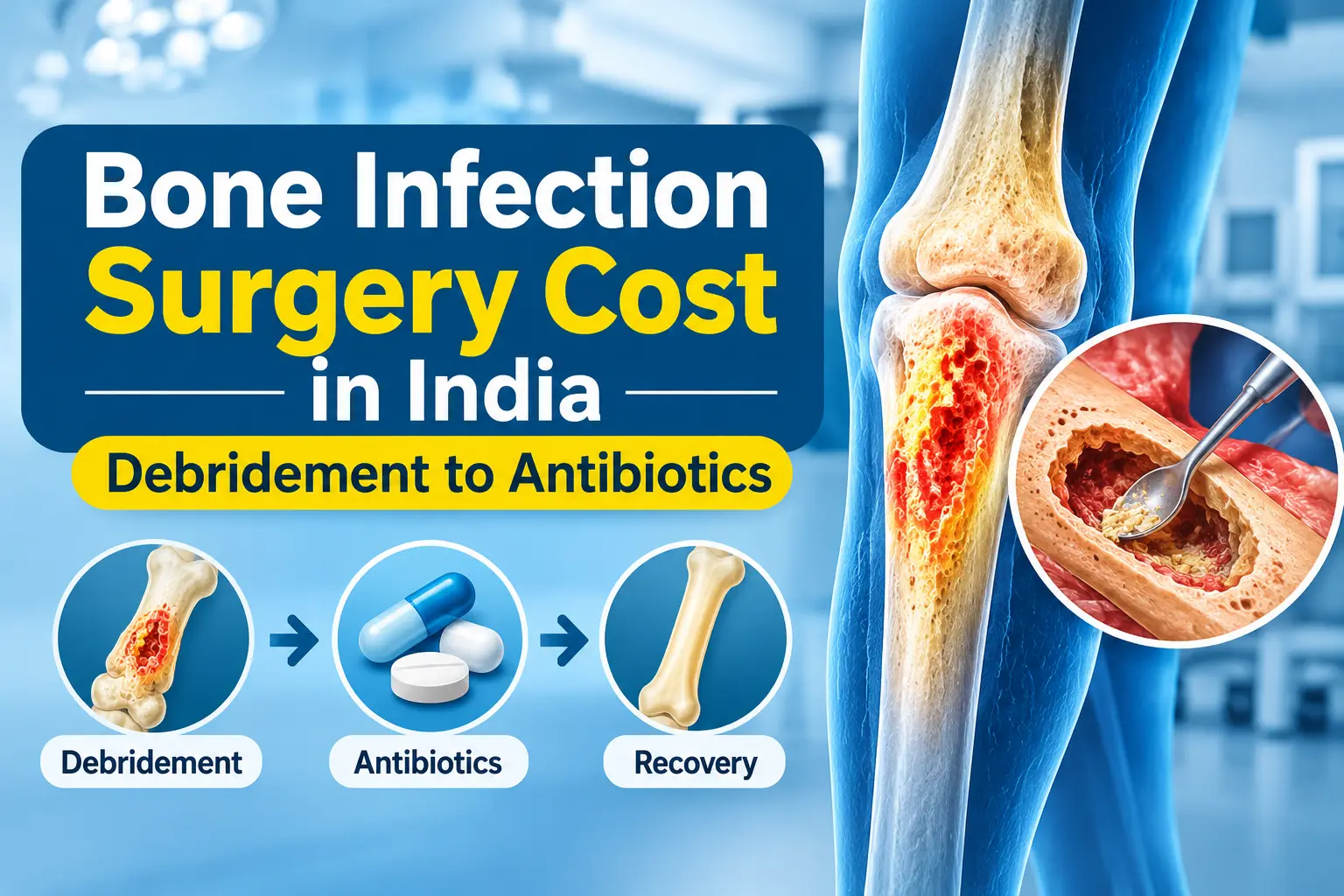
The cost of bone infection treatment in India depends mainly on how many cleaning surgeries (debridements) are needed, how long intravenous antibiotics run, whether antibiotic beads, spacers or new implants are used, and how long you stay in hospital. A single-stage case costs much less than staged reconstruction over several months. Getting it done properly the first time is almost always cheaper overall.
Cost is usually the second question families ask, right after “can it be cured?” It’s a fair question. Bone infection treatment can run over weeks or months, and a vague answer makes planning impossible. This guide breaks the bill into its parts so you can understand any estimate you’re given.
What does surgical bone infection treatment include?
Treating an established bone infection is rarely just a course of tablets. According to the MedlinePlus guide to osteomyelitis, antibiotics are usually given for at least 4 to 6 weeks, often intravenously, and surgery is needed to remove dead bone and any infected metal when antibiotics alone don’t work.
In practice, a complete treatment usually has these parts:
1. Investigations: blood tests, X-rays, often an MRI or CT scan.
2. Debridement surgery: removing infected and dead bone and soft tissue, and taking samples for culture.
3. Implant management: removing or exchanging an infected plate, nail or screws.
4. Local antibiotics: antibiotic beads or a cement spacer placed in the bone.
5. Systemic antibiotics: intravenous, then oral, for several weeks.
6. Reconstruction: filling or rebuilding the bone gap, sometimes with an Ilizarov frame.
7. Follow-up: blood tests, X-rays and wound checks for months afterwards.
What each part costs, and why it varies
| Cost component | What changes the cost |
| Tests and imaging | MRI or CT adds cost; repeat blood tests during treatment |
| Debridement surgery | Number of operations, theatre time, size of the area |
| Culture and sensitivity tests | Several samples are sent from each surgery |
| Antibiotics | Type of drug, IV vs oral, number of weeks |
| Beads or spacer | Antibiotic cement and the material used |
| Implants | Removal only, exchange, or a new frame for reconstruction |
| Hospital stay | Number of days and room category |
| Physiotherapy and follow-up | Months of visits, dressings and X-rays |
Estimated ranges at Sankalp Multi-Specialty Hospital
| Treatment pathway | Typical stay | Estimated range |
| Single debridement with implant retained and antibiotics | 5–10 days | ₹1.2 – 2.5 lakh |
| Implant removal, debridement and antibiotic beads | 7–14 days | ₹2.0 – 4.0 lakh |
| Staged treatment with later bone reconstruction | 10–21 days over 2+ admissions | ₹4.0 – 8.0+ lakh |
Your own estimate depends on your reports. A written estimate is shared after Dr. Goyal reviews your case.
Single-stage or staged treatment: why the cost differs
In single-stage treatment, the infected bone is cleaned, local antibiotics are placed and the problem is dealt with in one operation, followed by antibiotics. A systematic review of single-stage treatment of chronic osteomyelitis found this approach works well in carefully selected patients.
Staged treatment is used when there is a large bone gap, a loose or broken implant, poor skin cover or a stubborn germ. The first surgery clears the infection. A later surgery, weeks or months on, rebuilds the bone. Two admissions, two anaesthetics and a longer follow-up naturally cost more, but trying to do everything at once in the wrong patient often means the infection comes back.
Insurance, PM-JAY and cashless options
• Health insurance: bone infection surgery is medically necessary treatment and is generally covered. Check your room-rent limit, since it affects other charges.
• Cashless treatment: Sankalp works with insurers and TPAs including Star Health, ICICI Lombard, HDFC Ergo, Tata AIG and Medi Assist. Pre-authorisation is started at admission.
• Ayushman Bharat PM-JAY: eligible families get up to ₹5 lakh of hospital cover a year, and everyone aged 70 and above is now eligible regardless of income, as set out by the Press Information Bureau. Ask whether the hospital is empanelled for the procedure you need.
• Antibiotics after discharge: check whether your policy covers home IV antibiotics or only in-hospital treatment.
Why incomplete treatment costs more later
The most expensive bone infection is the one treated halfway. Repeated short antibiotic courses without surgery, or a quick wash-out that leaves dead bone behind, often quiet the infection for a few months before it returns. Each return usually means more bone lost and a bigger operation.
If you’ve already had two or three antibiotic courses and the wound keeps discharging, ask for a surgical plan rather than another prescription.
How to get a written estimate
Send your X-rays, any MRI or CT, culture reports, operation notes and a list of antibiotics you’ve taken. With these, Dr. Goyal can usually tell you whether the case looks like single-stage or staged treatment and give an estimate before you travel. You can send your reports for review here.
To understand how the full treatment pathway works, see our bone and joint infection page.
From the clinic, Dr. Tanay Goyal: “Families often ask me for the cheapest option. I understand why. But with bone infection, the cheapest first surgery is often the most expensive treatment in the end. I’d rather plan one proper debridement than three partial ones.”
Frequently asked questions
Does insurance cover bone infection surgery?
Usually, yes. It is treated as medically necessary surgery. Check room-rent limits, sub-limits on implants, and whether post-discharge antibiotics are covered.
How many surgeries does a bone infection usually need?
Some cases are treated in one operation. Others need two or more: one or more to clear the infection, and one to rebuild the bone. Your surgeon should tell you which is likely from your X-rays and scans.
How long are IV antibiotics given?
Typically for several weeks, often starting in hospital and continuing at home or switching to tablets. The exact length depends on the germ and the type of infection.
Are antibiotic beads expensive?
They add some cost for the cement and antibiotic, but they deliver very high antibiotic levels exactly where the infection is, which can shorten overall treatment.
Can I get an estimate from reports alone?
Yes, a reasonable estimate can usually be given from good X-rays, scans and previous reports. It may change after examination or if surgery finds more infection than the scans showed. Read our guide on osteomyelitis symptoms and causes to understand what the reports show.
Next step
If you’re comparing estimates, compare the plans too: number of surgeries, implants, antibiotic duration and follow-up. Send your reports for a written estimate from Dr. Tanay Goyal.
Medically reviewed by Dr. Tanay Goyal, MS (Orthopaedics), fellowship-trained in bone and joint infection management. Senior Consultant, Sankalp Multi-Specialty Hospital, Ambikapur.
This article is for general information. Costs shown are estimates and depend on each patient’s condition, hospital stay and treatment plan.