
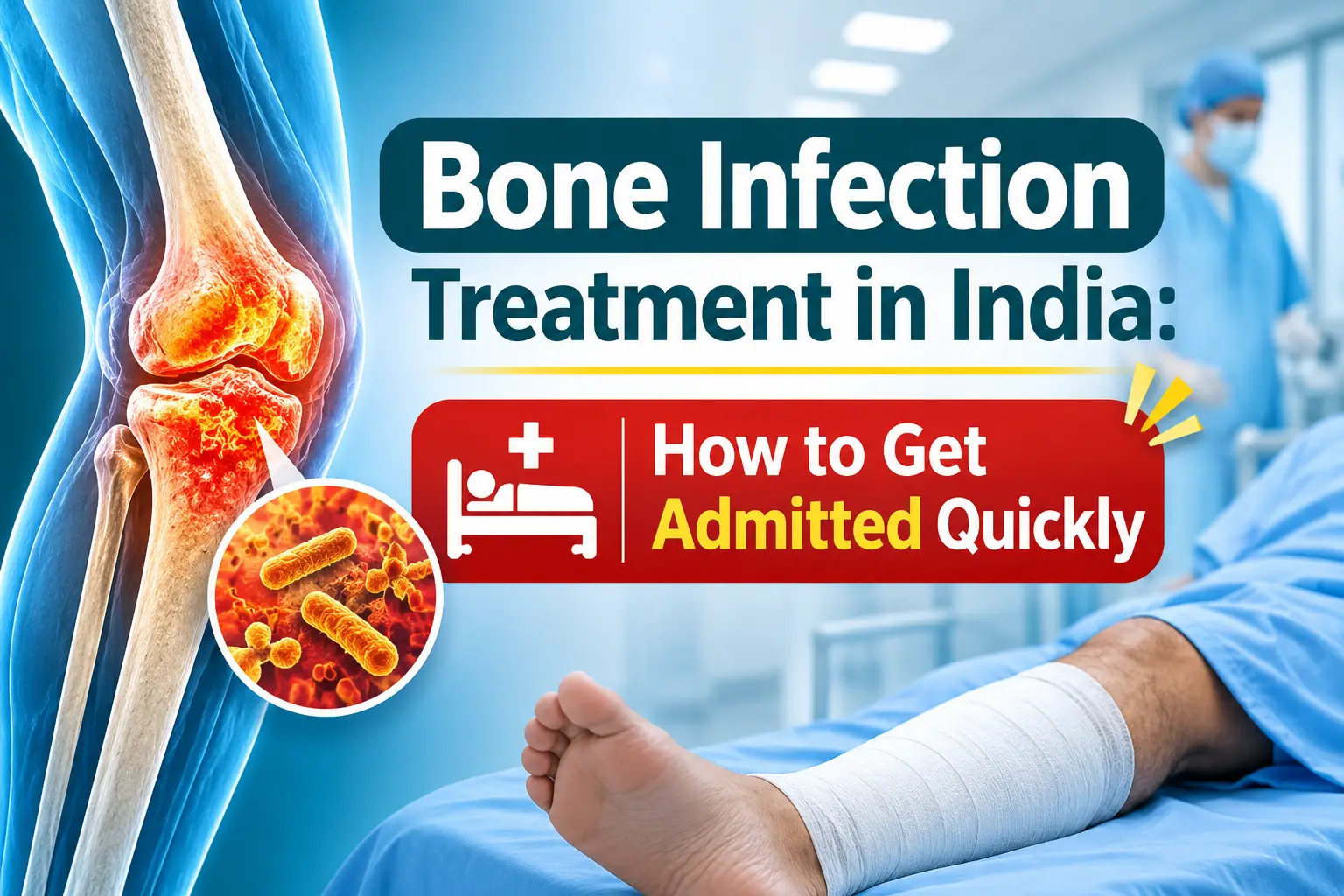
Advanced bone infection needs a hospital that can do surgical cleaning (debridement), send bone samples for culture, give the right antibiotics and rebuild the bone later, all under one roof. To get admitted quickly, call the orthopaedic team before you travel, send your X-rays and reports ahead, and carry every earlier discharge summary and operation note.
Bone infection is one of those problems where a few days really do matter. An infection that is caught early can often be treated while keeping the implant and the bone intact. Left for weeks, it spreads along the bone, loosens screws and makes the eventual surgery much bigger.
Which hospitals in India specialise in advanced bone infection treatment?
Large government institutes and some private specialty hospitals run dedicated bone infection or limb reconstruction services. What makes a centre “advanced” isn’t its size. It’s whether an orthopaedic surgeon trained in infection management leads the case, and whether the hospital can handle every step from the first cleaning surgery to the final reconstruction without sending you elsewhere.
If you’re far from a big city, you don’t necessarily need to travel to a metro. A regional hospital with a trained surgeon and a 24-hour orthopaedic emergency service can often start treatment the same day.
Signs that a bone infection needs admission now
Don’t wait for your next scheduled follow-up if you notice any of these:
• Fever with pain at the site of an old fracture or operation.
• Redness and warmth that is spreading, or swelling that keeps increasing.
• Pus, or a wound that reopens near the scar after it had healed.
• A hot, swollen joint you can barely move. This can be septic arthritis, which can damage the joint cartilage within days.
• Bone visible in a wound, especially in a diabetic foot.
• A child with fever who refuses to walk or use one arm or leg.
The MedlinePlus guide to osteomyelitis from the US National Library of Medicine lists the same warning signs, along with the people most at risk: those with diabetes, recent bone surgery, poor blood supply or a weak immune system.
What an advanced bone infection centre must have
| What to look for | Why it matters |
| An orthopaedic surgeon trained in infection management | Plans which bone and implant to remove, and how to rebuild afterwards |
| An operating theatre available at short notice | Urgent cleaning surgery shouldn’t wait days for a slot |
| Bone and tissue cultures sent from surgery | Antibiotics should be chosen for the actual germ, not guessed |
| Local antibiotic options (beads, cement spacers) | Delivers high antibiotic levels right where the infection is |
| Ring fixators and implants for reconstruction | Bone that is removed has to be rebuilt later |
| Wound care and soft-tissue cover | A healthy skin cover is part of curing the infection |
| Long follow-up | Bone infection can return months later |
Since 2018, doctors worldwide have used a shared definition of infection after fracture surgery, published by an international expert group in the journal Injury. A good centre will follow that approach rather than giving repeated antibiotic courses without a clear diagnosis.
Government or private: how fast can you get a bed?
Government medical colleges have experienced teams and treat many infection cases at very low cost. The trade-off is that planned admissions can involve a wait, and you may see different doctors at each visit.
Private specialty hospitals usually admit faster and keep you under one named surgeon. They cost more, though insurance and PM-JAY can narrow the gap.
If you have an active, spreading infection or a hot swollen joint, go to the nearest hospital with a 24-hour orthopaedic emergency service, whichever kind it is. Speed matters more than the label.
How to get admitted quickly, step by step
1. Call the orthopaedic team first. Explain the problem in two lines: where the infection is, when the surgery was, and what’s happening now.
2. Send photos of your reports on WhatsApp before you leave home: recent X-rays, blood tests and any culture reports.
3. Ask whether you can come straight to emergency or need to book an OPD slot.
4. Carry all your papers (see the list below).
5. Bring your insurance card or PM-JAY details so pre-authorisation can start at the desk.
6. Come with one family member who can stay, as infection treatment usually means at least a few days in hospital.
Reports and documents to carry
• ☐ All X-rays, including the very first one after the injury
• ☐ CT or MRI scans, on CD or phone
• ☐ Operation notes and discharge summaries from every earlier surgery
• ☐ Previous culture and sensitivity reports
• ☐ A list of antibiotics you have taken, with dates
• ☐ Blood sugar reports if you have diabetes
• ☐ Photo ID, insurance card or Ayushman card
How admission works at Sankalp, Ambikapur
Sankalp Multi-Specialty Hospital runs a 24-hour orthopaedic emergency service. If you call or message before travelling, the team can tell you whether to come straight to emergency or to the OPD, and Dr. Goyal can look at your reports in advance. Find directions and contact details on our contact page.
After admission, the usual first steps are blood tests, fresh imaging if needed, and planning the first cleaning surgery. Bone samples taken in theatre guide the antibiotic choice. You can read more about the full treatment pathway on our bone and joint infection page.
From the clinic, Dr. Tanay Goyal: “The most useful thing a patient can bring is the operation note from their first surgery. It tells me exactly what implant is inside and how it was put in. And if you can, check with your doctor before starting yet another antibiotic course just before coming in. It can make the bone cultures come back negative, and then we’re treating blind.”
Frequently asked questions
Is a bone infection an emergency?
It can be. A hot, swollen joint, fever with bone pain, or rapidly spreading redness needs same-day attention. A long-standing infection with a small discharging wound is less urgent but still shouldn’t wait weeks.
Can I be admitted directly without an OPD visit?
If you’re unwell, with fever or severe pain, you can usually come through the emergency department. For stable, long-standing infections, a quick OPD review first helps plan the admission properly.
Which reports should I carry?
All X-rays, scans, operation notes, discharge summaries, previous culture reports and a list of antibiotics you’ve taken. The operation notes are the most often forgotten and the most useful.
How long is the hospital stay for bone infection?
It depends on the infection. A single cleaning surgery may need a few days in hospital. Staged treatment can involve two or more admissions, with antibiotics continued at home in between.
Can treatment start before culture reports come back?
Yes. If you’re unwell, doctors start broad antibiotics after samples are taken, then switch to a targeted antibiotic once the culture result is ready, usually within a few days. For more on symptoms and causes, see our guide to osteomyelitis (bone infection).
Next step
If you have pus, fever or rising pain at an old surgery site, call before you travel and send your reports ahead. It saves time at the hospital and gets treatment started sooner. Find our contact details and directions here.
Medically reviewed by Dr. Tanay Goyal, MS (Orthopaedics), fellowship-trained in bone and joint infection management. Senior Consultant, Sankalp Multi-Specialty Hospital, Ambikapur.
This article is for general information and doesn’t replace a consultation. If you have fever with severe pain or a hot swollen joint, seek emergency care.